
“Change is hard.”
Is it?
What if that’s just an opinion disguised as a fact? What if that is just a socialized complaint/expression that we’ve all been brainwashed into believing and repeating?
“Change is hard” can often be heard as an unconscious declaration of an inevitable, early surrender from the leader to the team that they are responsible for leading.
“Change is hard” often sounds like a veiled equivalent to: “Yes, I’m the boss, but I’m not going to be taking responsibility for implementing/supporting the new strategy or the business results….because change is hard.”

There are, however, many corporate executives and entrepreneurs alike who get excited about the possibility of change; they are masters at it; it’s easy for them. They would never say, “Change is hard.” So the “hardness” of change might not be an absolute truth. I’m not sure it’s true at all. “Hardness” may be a measure of mineral’s scratch resistance (e.g., Mohs’ scale), but “hard” is not necessarily an attribute of change. Is it?
“Hard” or “easy” (success or failure) is usually a relative comparison of two things: 1) the challenge and 2) our ability/inability to respond to the challenge effectively. Whether the challenge is to squat 300 pounds or to engage in expanding corporate competencies, there’s two ways to approach it: I can say, “300 pounds is too heavy,” or I can say, “300 pounds is too heavy for me. My leg muscles aren’t strong enough to squat 300 pounds.”
HARD is only relative to our ability to respond. HARD is not an attribute of change.
If our muscles aren’t ready for the challenge, then the challenge/change is harder for us. That same challenge may NOT be hard for others. Change (innovation) is not hard for leaders and teams whose muscles are developed/trained and ready to respond effectively.

Chief innovation officers (CINOs), transformation experts and executives who have learned from experience will agree that change (innovation) is harder when:
- We wait too long to get started or lollygag through the process of starting.
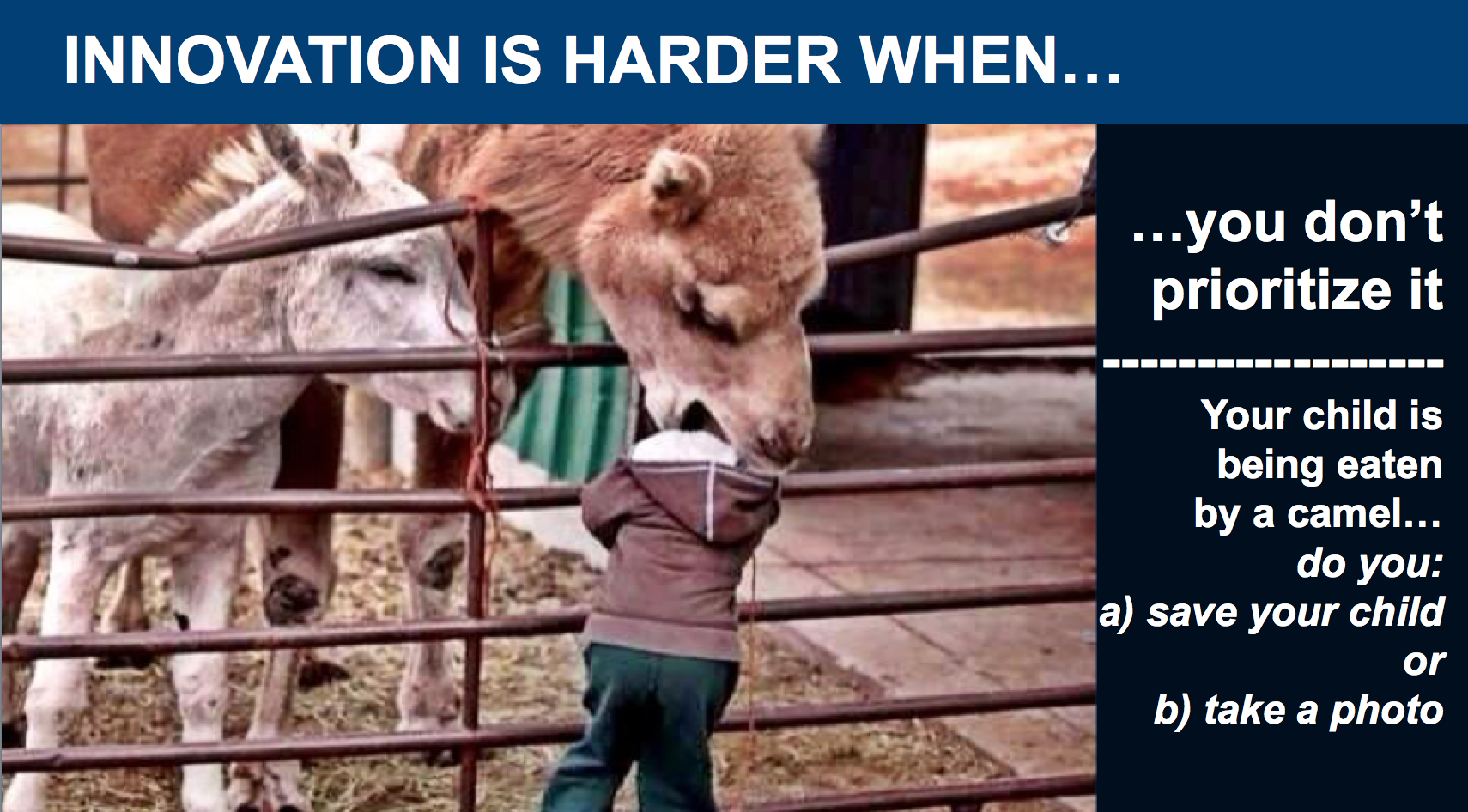
- We don’t prioritize it; we don’t have a plan or resources dedicated to it; we haven’t separated the essential from the important.
- We treat it like an event versus a lifestyle; we don’t walk the talk.
- We don’t use expert tools and processes; we wing it or “amateur-hour” it.
- We don’t create the space (culture) for creativity, collaboration, etc.; we try to command and control culture change.
- We’re not aware of our default, reactive language and habits; we hang on to old success formulas for too long.

7. We don’t ask for help; we pretend we know what to do when we don’t.
==========================================================================

Experienced CINOs, transformation experts and executives will also agree that change (innovation) is easier when:
- You see more: You’re more conscious (less likely to be driven by default, reactive habits), more awake, more open to learn and more curious to explore multiple perspectives beyond your own (conscious leaders make better innovation leaders).
- You collaborate better: You’re more skilled at engaging and empowering people to use innovation tools/processes effectively; you’re more skilled at healthy debate, committed action and accountability; your leadership and culture of the organization help diverse groups of people feel powerfully valued and powerfully challenged.
- You feel stronger: Your energy is sourced from a higher-order purpose — values and guiding principles are unconditional; you are grounded in sources of certainty that help you make decisions and take action in the face of increasing uncertainty.

We might expect to hear “change is hard” from stereotypical leaders/politicians when they shirk accountability and make a career out of saving face and preserving their innocence versus keeping their promises. But it never makes sense when accomplished, successful leaders responsible for change inside of powerful and abundantly resourced organizations say, “Change is hard.” However, we hear it all the time in reference to corporate initiatives that involve: a) doing something new versus doing the usual/status quo and b) letting go of old default habits in favor of more effective habits. You’ll hear it in every innovation/transformation and change management meeting. You’ll hear it in every systems implementation, digital integration and customer experience session when the experience involves a people-centric service or delivery system. When a leader responds to these kinds of challenges regarding learning, complexity and ambiguity (aka innovation/change/growth) with the “change is hard” hedge, the change does in fact get 1,000 times harder. It gives the organization permission (from the top) to lower their standards. It gives everyone permission to resist learning/training — permission not to grow — permission not to be a part of changing because, after all, “change is hard.” The boss even said so! In these contexts, it serves as an early and convenient scapegoat to hide the leaders’ inference that their teams’ muscles might not be ready to follow through and deliver. When the team isn’t ready, that’s the leader’s fault. Don’t blame the team and don’t blame the culture. Your team can do it. They need an innovation leader to lead them. That’s you.
In today’s VUCA (volatile, uncertain, complex and ambiguous) environment, unskillfully declaring, “change is hard” is nothing more than an expression of the victim — a choice of powerlessness and incompetence hiding behind an external circumstance, portrayed as something out of our control. A creator/player would never say that. It is true that I won’t be able to change/innovate effectively if my muscles (and the organization’s muscles) are not ready. But the hardness is relative to my muscular readiness. If I were more ready (if my organization was more ready), I could do it more effectively. Instead, my mind will go immediately to blaming the change itself for being too hard.
If you’re the leader of your business, department, community or family, stop saying, “change is hard.” Try this instead: “I don’t think I’m ready” or “my team and I aren’t ready for change. We need to be more ready.” Ask, “How can my team and I get more ready?” That’s what a player/creator would do. Then we will see if that helps us focus and find an even more effective response to dealing with change. We might as well choose to change (and stop blaming it for our poor results) since change is going to keep coming, whether we are ready or not.
Being a creator/player does not mean that I/we will magically be able to change everything and anything. Being a creator/player means I need to train because the speed of change/VUCA and the challenges I have in front of me have exceeded my ability to handle them. It is essential for me and my team to develop an expanded capacity for change — or as Argentine Ricardo Gil, Axialent chief culture officer…aka RichiWanKenobi, would say,
“Learn to live at peace with the difficulty and suffering you’ve chosen by not developing (the appropriate growth muscles).”
Don’t be a victim. Victims can’t innovate, and they don’t usually change without creating permanent damage and unnecessary suffering. That can be avoided. Change is easier when you train for it. It’s harder when you don’t. Drop everything and train #d3&t. “Don’t just be a better leader, be an innovation leader.” Train to be a Jedi. See more, collaborate better and feel stronger (build those muscles and you’ll be more Jedi). The world needs more Jedi.
Focus on separating the essential from the important. It is critically important that we get the DOING innovation management stuff right (e.g., process, strategy, metrics). But don’t minimize the innovation essentials (e.g., people, leadership, culture) just because we think the people/change part is “hard.” Prioritize the essential and it becomes easier.
The important goes on the to-do list.
The essentials go on a to-die-for list.