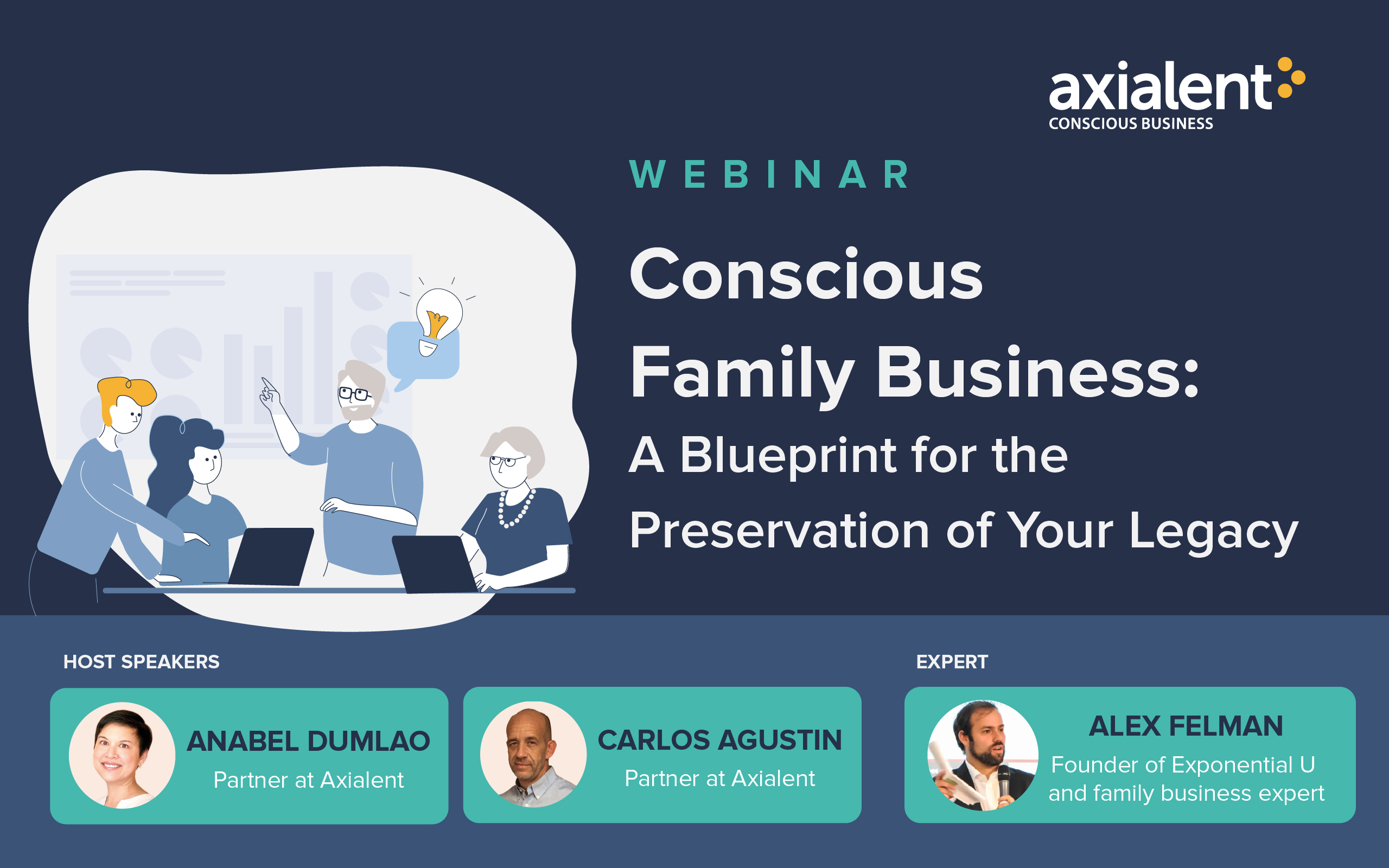
Conscious Family Business: A Blueprint for Legacy Preservation 

Family businesses hold a unique position in the global economy, combining tradition, entrepreneurship, and emotional ties. However, preserving their legacy requires intentional strategies that address behavioral risks, values alignment, and intergenerational collaboration. With only 30% of family businesses surviving into the second generation, 12% to the third, and 3% to the fourth, according to the Conway Center for Family Business, the stakes are high.

This article explores the key principles of a conscious family business, inspired by insights shared in our recent webinar with experts Alex Felman, founder of Exponential U and Subject Matter Expert and Carlos Agustin, Partner at Axialent and Subject Matter Expert hosted by Anabel Dumlao, Partner at Axialent. 

Why Family Businesses Need Consciousness 

Family-owned businesses often face distinct challenges: 

  • Balancing personal and professional dynamics. 
  • Transmitting core values across generations. 
  • Preparing successors for leadership roles. 

Carlos highlighted the importance of achieving balance across three critical dimensions: the “It” (business results), the “We” (family dynamics), and the “I” (individual well-being).
A conscious approach integrates these elements, ensuring sustainable growth and harmony.

However, a Harvard Business Review study reveals that 70% of families lack a succession plan, a critical gap that undermines their long-term viability.
Leadership transitions remain one of the primary reasons for failure, with 50-70% of all new executives failing, according to a Corporate Executive Board report. 


The Role of Core Values 

Values serve as the foundation for decision-making and legacy building. Alex, emphasized that transferring entrepreneurial mindsets and maintaining a growth-oriented culture are essential. However, conflicts may arise when generational perspectives diverge, especially regarding: 

  • Strategic priorities. 
  • Governance structures. 
  • Work-life balance. 

Generational dynamics add another layer of complexity. 85% of rising generations feel ready to take control, but only 39% of those currently in power agree, according to the Camden Wealth 2022 report. This disconnect often fuels misunderstandings and stalls progress. Aligning around shared values fosters a unified vision for the business’s future. 

Addressing Behavioral Risks 

Behavioral risks, such as unresolved conflicts or unclear roles, can jeopardize the longevity of a family business. Using the metaphor of an iceberg, Carlos explained that most issues stem from “beneath the surface,” such as: 

  • Misaligned beliefs. 
  • Emotional grievances. 
  • Lack of meaningful communication. 

Proactive conversations, supported by trust and emotional intelligence, help families navigate these challenges. Without addressing these underlying dynamics, 70% of change management efforts fail, according to a Harvard Business Review report, underscoring the need for conscious leadership. 

Practical Steps for a Conscious Family Business 

  1. Establish Governance Structures : Clear roles and decision-making frameworks ensure accountability and reduce power struggles. 
  2. Prioritize Open Communication : Schedule regular family meetings to discuss business and personal goals. 
  3. Foster Intergenerational Education: Combine technical and human skills development for younger members, including negotiation, feedback, and conflict resolution. 
  4. Develop a Shared Narrative : Carlos recommended creating a “family story” to instill pride and commitment among members. 
  5. Measure and Align Goals : Tools like the Family Office Navigator can assess financial and emotional capital, aligning the family’s vision with actionable steps. 

Building a conscious family business is a dynamic process that requires continuous effort and collaboration. By focusing on trust, intentionality, and shared values, families can preserve their legacy and thrive across generations. As Alex Felman put it, “Consciousness begins with self-awareness—knowing where you are today and deciding where you want to go.” 

Share this:
axialent-schedule-2026

What brings you here?

axialent-contact-form-2026

What brings you here?

Transformación Digital que Empieza con la Transformación Humana

La mayoría de las transformaciones digitales fracasan. Las empresas invierten millones en nuevas herramientas y procesos, pero la adopción se estanca. La razón: se enfocan en la tecnología y la estrategia mientras ignoran cómo las personas piensan, sienten y colaboran.
Empezamos por el lado humano. Los líderes y los equipos enfrentan los miedos, los hábitos y las dinámicas culturales que impiden la adopción. Construyen nuevas mentalidades, comportamientos y prácticas que hacen que el cambio perdure.

El resultado: las personas adoptan nuevas herramientas. Nuevos procesos. Nuevos sistemas. Y el impacto en el negocio llega naturalmente.

Transformación Digital y Adopción de IA

No se trata solo de la adopción de tecnología; se trata de la adopción humana de la tecnología.

La mayoría de las transformaciones digitales fracasan. Las empresas invierten millones en nuevas herramientas y procesos, pero la adopción se estanca. La razón: se centran en la tecnología y la estrategia mientras ignoran cómo las personas piensan, sienten y colaboran.

Empezamos por el lado humano. Los líderes y los equipos se enfrentan a los miedos, hábitos y dinámicas culturales que impiden la adopción. Construyen nuevas mentalidades, comportamientos y prácticas que hacen que el cambio se consolide.

El resultado: la gente adopta nuevas herramientas. Nuevos procesos. Nuevos sistemas. Y el impacto empresarial sigue de forma natural.

Una clase magistral para líderes que guían la transformación digital y de IA.

Se centra en el cambio de mentalidad necesario para liderar el cambio.

Al combinar el potencial humano con la innovación, ayuda a los líderes a construir culturas adaptativas y preparadas para el futuro.

Los gerentes y líderes de equipo necesitan repensar su rol en la era de la IA. Ya no se trata de controlar tareas; se trata de habilitar resultados, moldear mentalidades y crear las condiciones donde los equipos y la tecnología puedan prosperar juntos.

Esta masterclass ayuda a los líderes a:

  • Cambiar su mentalidad de “dueño de tareas” a “facilitador de resultados”.
  • Liderar a los equipos a través de la adopción de IA moldeando nuevas normas y hábitos.
  • Equilibrar el uso ético de la IA con la delegación inteligente del trabajo.

El potencial de la IA no puede cumplirse sin un liderazgo que sepa cómo hacerlo realidad. Este programa está diseñado para líderes ejecutivos que necesitan:

  • Desarrollar una mentalidad digital que conecte la estrategia de IA con los resultados del negocio.
  • Comprender cómo la cultura de trabajo y el liderazgo, no solo las herramientas, hacen que la transformación se consolide.
  • Liderar con claridad, equilibrando la velocidad de adopción con la ética y el valor a largo plazo.

¿Qué incluye?

– Autoevaluación: Ofrece una línea base sobre su estilo de liderazgo y potencial de crecimiento.

– Día 1: Convertirse en un Líder Digital Consciente

– Día 2: Transformar la Cultura y la Estrategia a Través de la IA

La mayoría de a los empleados de primera línea se les exige trabajar con IA antes de sentirse realmente seguros. Este programa cierra esa brecha al dotar a los equipos de conocimientos fundamentales y habilidades prácticas para usar la IA en sus roles diarios, mientras se mantienen anclados en los valores y la toma de decisiones conscientes.

¿Qué incluye?

Módulo 1: Comprender la IA en su lugar de trabajo

Módulo 2: Adoptar el Liderazgo Digital Consciente

Módulo 3: Introducción a las Herramientas de IA

Módulo 4: Integrar la IA en la Práctica Diaria

Formato: Módulos autodirigidos + 2 sesiones virtuales facilitadas (1.5 h cada una)

Cuando las organizaciones adoptan la IA, la Cultura Laboral es el factor decisivo. Este programa ofrece a los líderes un cambio de perspectiva crucial: prepare su Cultura Laboral para la IA, y la adopción vendrá después.

¿Qué incluye?

– Autoevaluación: Proporciona una línea base sobre su estilo de liderazgo y potencial de crecimiento.

– Sesiones en vivo: 7 sesiones (aproximadamente 3 horas cada una)

– Autodirigido: 3 módulos (2 horas cada uno, opcional)

– Extras: networking, intercambio entre pares y ejercicios prácticos

Diseñado en colaboración con Duke Corporate Education para fusionar el rigor académico con el conocimiento práctico.

Saber más.

Organizational Agility & Adaptability

Most companies chase agility through new processes and frameworks. But speed alone doesn’t solve silos, resistance, or burnout. Too often, the focus is on mechanics while the human foundations are ignored.

We build agility from the inside out. Leaders and teams shift from control to trust, from perfection to experimentation, from passivity to ownership. Collaboration and psychological safety turn agility from a toolset into a way of working.

The result: Individuals move from doing agile to being agile. Teams align. The organization moves at the speed of change.

Most leadership programs stop at skills and tools. But in today’s world, agility is less about running faster and more about shifting how leaders think, act, and show up. Without mindset and behavior change, agile frameworks remain surface-level and fail to transform organizations. We help leaders move from awareness to action.

What’s included:

  • Assessment to reveal leadership style and identify enablers and blockers to agility
  • M1: Leading from Mindset – Uncover their mental models, clarify which habits to shift, and commit to personal experiments that build adaptability.
  • M2: Leading Through Behavior – Translate insights into daily practices—collaborating, discovering, and seizing opportunities—while aligning with peers on a shared leadership approach.
  • Practice & Coaching – Between sessions, leaders apply new habits, get feedback, and refine through 1:1 coaching and team commitments.

The result: leaders who don’t just do agile, but lead with agility—equipping their teams to adapt, align, and thrive at the speed of change.

This program helps Leaders to better understand the power of their mindsets as a critical lever for succeeding with the Agile transformation. Participants will enhance essential skills needed in the Agile world –  and know how to use them to foster adaptability, innovation and speed in their teams. They will Increase the efficiency of their teams by encouraging self-responsibility, self-organization and feedback and by engaging them for new ways of working together

Silos slow organizations down, weaken collaboration, and limit innovation. This program helps leaders break them down by building the mindset and skills to foster stronger cross-functional partnerships.

Participants learn to manage polarities, map and engage stakeholders, and use collaborative communication techniques that drive alignment and shared goals. Through interactive exercises and real-world applications, leaders practice shifting from isolated thinking to enterprise-wide collaboration.

The outcome: a leadership culture that values partnership, strengthens organizational effectiveness, and unlocks the power of collective impact.

Formats: 1-day in person | 2 × 4h virtual sessions